

Tin Phosphorus Master Alloy
Our premium tin phosphorus master alloys are engineered specifically for primary manufacturers across a diverse spectrum of global metallurgical applications. Formulated with high-purity virgin tin and precisely controlled additions of phosphorus, these specialised formulations act as high-performance deoxidisers, grain refiners, and anti-drossing agents. They ensure absolute structural reliability, exceptional batch consistency, and minimised operational waste across automated wave soldering, industrial foundry casting, and advanced electroplating processes worldwide.
Supported Global Industrial Applications
+
Our tin phosphorus master alloy profiles are tailored to meet the strict production requirements of multiple industrial sectors:
- Electronics Assembly: Crucial anti-drossing additive for automated wave soldering and selective soldering lines (SAC ranges), dramatically reducing tin oxidation during component assembly.
- Industrial Electroplating: High-purity alloying input for the production of phosphorised copper anodes, ensuring uniform dissolution rates in advanced printed circuit board (PCB) plating baths.
- Foundry Casting & Metallurgy: Vital deoxidiser and grain refiner used to manufacture high-performance phosphor bronze, brass, and specialized engineering casting alloys with zero porosity defects.
- Chemical Equipment Production: Critical constituent used to enhance the fatigue limit, tensile strength, and exceptional corrosion resistance of raw materials destined for harsh chemical processing environments.
Key Technical Advantages
Dross Reduction
Significantly lowers the rate of tin oxidation, directly reducing expensive dross waste in your wave solder and casting baths.
Joint Brightness
Minimises surface dullness caused by oxidation, ensuring clean, bright, and highly inspectable solder joints and castings.
99.9% Virgin Base
Alloyed using strictly 99.9% pure virgin tin and trace element additives to eliminate contamination risks.
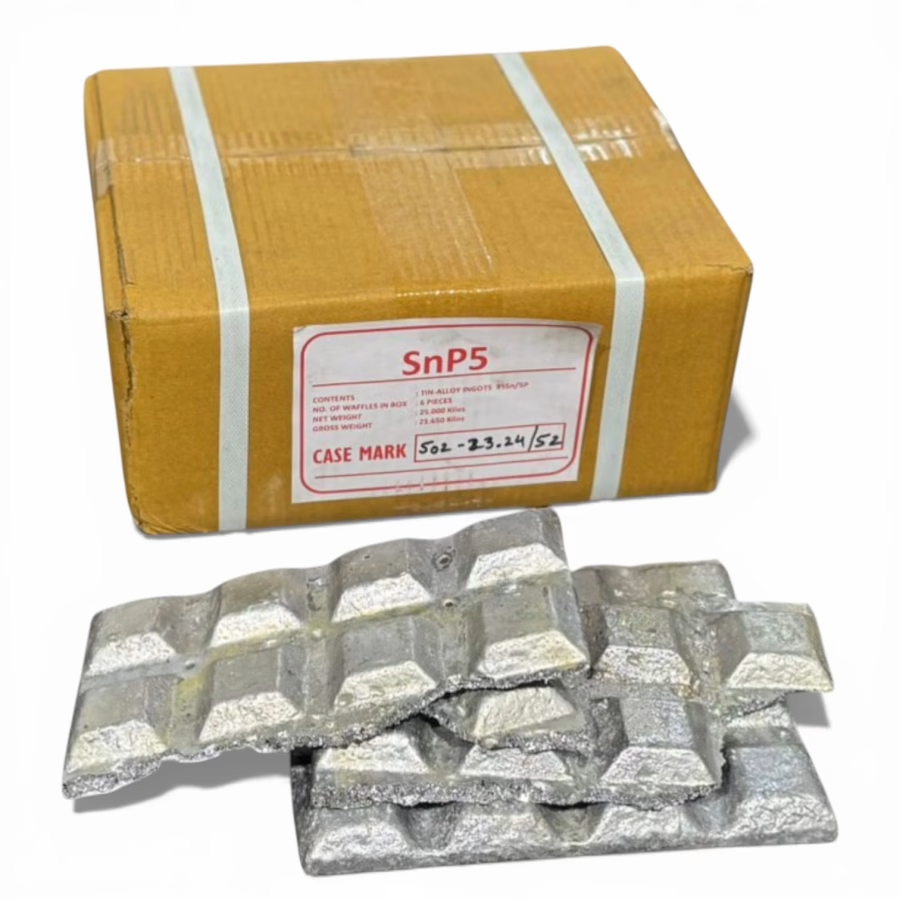
Standard Formats: Available in 5%, 3%, and 1% Phosphorus (balance Tin). Supplied as a 4kg waffle plate which is easily broken into small chunks for accurate additions, 5kg ingots, 2.5kg ingots, or 80g discs.
Melting Range Profiles
| Alloy Grade | 95Sn-5P (5% Phosphorus) | 97Sn-3P (3% Phosphorus) | 99Sn-1P (1% Phosphorus) |
|---|---|---|---|
| Celsius Range | 520 to 540°C | 475 to 495°C | 375 to 395°C |
| Fahrenheit Range | 968 to 1004°F | 887 to 923°F | 707 to 743°F |
Chemical Specification of SnP
| Element Tested | Symbol | 95Sn-5P Range | 97Sn-3P Range | 99Sn-1P Range |
|---|---|---|---|---|
| Tin | (Sn) | 94.5 % to 95.5% | 96.5 % to 97.5% | 98.5 % to 99.5% |
| Phosphorus | (P) | 4.5 % to 5.5 % | 2.5 % to 3.5 % | 0.5 % to 1.50 % |
| Tin + Phosphorus | (Sn+P) | 99.9% Minimum | ||
| Antimony Max | (Sb) | 0.030 % Max | ||
| Lead Max | (Pb) | 0.030 % Max | ||
| Bismuth Max | (Bi) | 0.010 % Max | ||
| Copper Max | (Cu) | 0.020 % Max | ||
| Arsenic Max | (As) | 0.010 % Max | ||
| Iron Max | (Fe) | 0.010 % Max | ||
| Cadmium Max | (Cd) | 0.001 % Max | ||
| Zinc Max | (Zn) | 0.001 % Max | ||
Global Supply & Export Logistics
DKL Metals manages an established worldwide distribution network, facilitating direct, unrestricted export pipelines to electronics assembly plants, industrial laboratories, and foundry hubs globally. Our international logistics infrastructure supports seamless transit across all major global trade lanes, ensuring all materials fully comply with international quality standards. All wholesale cross-border shipments are securely packed to preserve batch purity and arrive complete with full independent laboratory analysis certificates to guarantee effortless customs clearance and absolute supply chain traceability.
Tin-Phosphorus (SnP) Master Alloy FAQ
How should SnP master alloy be added to a tin or copper bath? +
Clear the bath surface of dross. Do not add phosphorus directly to a pure copper bath, as the extreme temperature will burn off the phosphorus. Instead, scoop a small portion of tin or base alloy into a ladle or container, heat it locally to around 450°C, and stir the SnP master alloy into the ladle until completely dissolved. Finally, stir thoroughly back into the bath to ensure a homogeneous dissolution.
How does phosphorus content affect the melting point of the alloy? +
As phosphorus content increases, the overall melting point of the alloy rises. This occurs because adding phosphorus introduces hard, high-melting-point intermetallic compounds like Sn4P3. These compounds raise the temperature required to achieve full fluid liquefaction.
How does Tin-Phosphorus compare to Tin-Germanium for dross suppression? +
While both act as antioxidants, SnP is preferred for aggressive dross reduction and lowering surface tension. SnGe (Tin-Germanium) forms a clear, invisible oxide skin that preserves a shiny joint appearance. SnP is typically chosen for cost-effectiveness and raw deoxidising power, whereas SnGe is preferred when cosmetic brilliance and minimising electronic component voiding are critical.
What are the risks of improper phosphorus levels in tin alloys? +
Under-dosing results in rapid dross and poor wetting. Over-dosing causes brittle joints, sluggish flow, and a severe hardware risk: excess phosphorus strips the protective oxide layer inside steel pots and nozzles. Once compromised, molten tin directly dissolves the underlying machine metal, causing rapid equipment erosion.
How should SnP master alloys be stored to prevent oxidation? +
To maintain metallurgical purity, SnP must be stored in a clean, dry, climate-controlled area inside sealed containers. Eliminating exposure to high humidity prevents surface oxidation and moisture absorption, which can cause sluggish melting and introduce unwanted dross.