

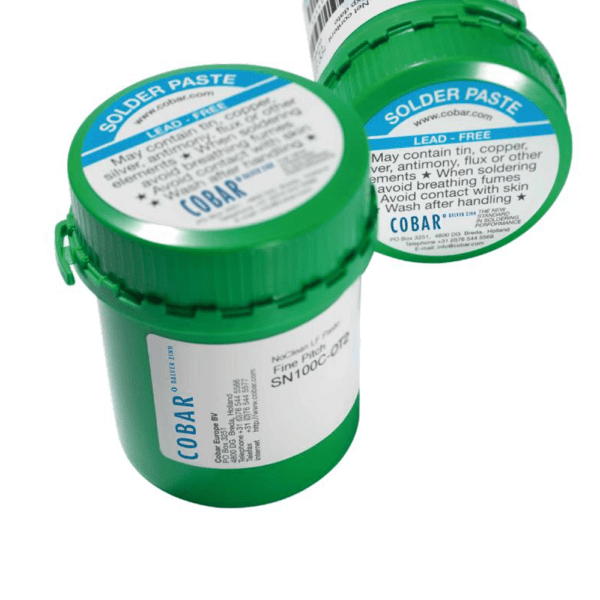
Cobar OT2 Lead-Free Solder Paste
Official Partner and UK Distributor
DKL Metals Ltd is the official UK distribution partner for Balver Zinn and Cobar electronics assembly materials. The Cobar OT2 no-clean solder paste platform represents the next generation of high-reliability SMT assembly line optimization. Formulated with a completely halogen and halide-free flux chemistry, this paste series is engineered to deliver defect-free printing and exceptional wetting across complex PCB topologies.
🛠️ Core Technical Specifications
This versatile flux system provides a wide process window for modern surface mount technology, meeting strict environmental compliance and high-speed production line demands.
| Process Parameter | Specification Details |
|---|---|
| Flux Classification | ROL0 (Halogen & Halide Free No-Clean) |
| Maximum Print Speed | Up to 200 – 250 mm/s |
| Recommended Squeegee Pressure | 0.20 – 0.25 kg/cm (at 23 °C ambient) |
| Optimal Operating Environment | 22-28 °C and 30-70% Relative Humidity |
| Open Stencil / Tack Time | Up to 24 Hours post-printing |
📦 Powder Size Availability: We stock and supply the OT2 flux chemistry across multiple standardised particle distributions to match fine-pitch components and precise stencil apertures.
Type 3 Powder (T3)
The standard industry choice for reliable, general-purpose electronics manufacturing and classic SMT component spacing.
Type 4 Powder (T4)
Engineered for fine-pitch printing applications, small passive components, and high-density PCB geometries.
🔬 Available Alloy Configurations
Select your alloy compound based on your specific joint strength, processing temperature, and manufacturing cost targets.
Cobar OT2 SN100C® Solder Paste (Silver-Free Lead-Free) +
Utilising the patented nickel and germanium stabilised tin-copper alloy (Sn99.3/Cu0.7/Ni0.05/Ge0.005), Cobar OT2 SN100C features a eutectic melting point of 227 °C. This silver-free formulation reduces intermetallic growth, prevents drossing, and acts as a highly cost-effective, high-reliability alternative to SAC305 alloys.
Cobar OT2 SAC305 Solder Paste (Industry Standard Lead-Free) +
Formulated with the industry-standard Sn96.5/Ag3.0/Cu0.5 composition. Combining the SAC305 alloy with the active OT2 flux system provides excellent mechanical joint strength, optimal thermal fatigue resistance, and low-voiding performance across a wide profile window.
❓ Frequently Asked Questions
What is the recommended storage temperature for Cobar OT2 solder paste? +
After receiving your solder paste from DKL Metals, it should immediately be stored between 8 °C and ambient room temperature. Unlike traditional pastes, DO NOT store Cobar OT2 in a standard refrigerator or below 8 °C, as low temperatures can compromise the stability of this specific chemistry. Always store cartridges horizontally and rotate them monthly to eliminate flux segregation.
Do I need to clean Cobar OT2 no-clean flux residues after reflow? +
No. Cobar OT2 is a true no-clean formula. The clear residues remaining on the printed board assembly (PBA) after soldering are completely chemically inert, non-conductive, and safe to leave on the board. However, if cosmetic cleaning or subsequent conformal coating is required, residues can be removed using Cobar MCA-1424 aqueous cleaner. Misprints and stencil tools can be cleaned with MCI-2330.
How do I prevent graping and head-in-pillow defects with OT2 flux? +
The Cobar OT2 platform features an advanced activator system specifically engineered to eliminate graping and head-in-pillow (HiP) defects during reflow. To maximize its effectiveness on poor-wetting board finishes, utilise a linear reflow profile. Ensure your flux activation time (FAT) between 150 °C and 200 °C remains between 20 to 150 seconds, with a peak reflow temperature between 240 °C and 260 °C.
What are the optimal printer squeegee settings for high-speed SMT lines? +
Printing speeds between 25–100 mm/s, apply a squeegee pressure of 0.20 kg/cm. For high-speed SMT printing between 100–200 mm/s, increase pressure slightly to 0.25 kg/cm. It is recommended to decrease pressure by 5% for every 1 °C rise in ambient temperature above 23 °C. If your printing line halts for more than 4 hours, a total stencil clean is highly recommended before restarting.
💡 Looking for a UK-Manufactured Alternative?
If you want matching performance directly from our domestic production line, why not try DKL Clearflow DK-P6?